Drink In Life
Savoring Life, Writing Through It
Mastrogiannis Distillery & Winery-Rosé For Cure
What words would you use to describe your mom? Beautiful, brilliant, caring, funny, giving? No matter how you describe your mom, she deserves to be celebrated. As Mother’s Day inches closer (it’s May 9th) now is the time to let your mom know how much you appreciate everything she does with a special gift. Even if she says “I already have everything I need” consider getting her a gift that equals her generosity, a Mother’s Day gift that will not only make her smile but one that gives back and helps others as well.

For the mom who likes to “wine” down and who is passionate about making the world a better place there is a Washington Rosé that can take care of both of those requests, Rosé for Cure from Mastrogiannis Distillery & Winery.
Every day thousands of children are diagnosed with illnesses and are fighting for their lives. As parents and small business owners, Ilias and Bojana Mastrogiannis knew that they had to do something to help the children and their families. Contemplating how to help Ilias and Bojana were inspired to start Rosé for Cure in July of 2020. Bojana told me, “During its inaugural release we came across a little girl named Sofija, who was battling a life-threatening disease. We decided to donate 100% of our wine sales to her family to help raise money for her medical treatment.”
The Mastrogiannis’ like to say that “Children are our future!”
Bojana shared, “This is one of the slogans that they started using with the belief that each child, especially those battling illness, deserves a chance in life. They should be able to grow up and have their dreams become a reality and some may even change the world!”

The outpouring of gratitude and the family’s relief for the support prompted them to extend the initiative and help more children. Rosé for Cure now donates 10% of every bottle sold directly to a sick child and their family with funds given out every six months. Keeping the needs of their families in mind, Rosé for Cure donates its proceeds directly to families with no strings attached or requirement for how the funds are allocated. Unconditional cash transfers (UCTs) are ideal as they allow for flexibility in accommodating the financial needs of families as they navigate illness.
“When we did our initial fundraiser we got a huge response and lots of support, and the momentum has only continued with Rosé for Cure. We are hopeful that by spreading the word about our cause we will succeed in supporting a lot of families.” -Bojana Mastrogiannis
To Cure A Rose
During the month of April 2021, the Mastrogiannis’ are donating 100% of their Rosé sales in addition to the $1,800 they have already raised to the ‘To Cure A Rose Foundation’. To Cure A Rose Foundation was started by Casey McPherson to help his 5 year old dauthger, Rose and other children who are battling a rare genetic disease called HNRNPH2. There is currently no cure for HNRNPH2, but Casey has connected with research scientists to help him find a cure for this disease.
HNRNPH2 is a rare genetic condition involving a gene on the X chromosome. It encodes the protein HNRNPH2 that helps gene messaging inside the cell, a function fundamental to brain development. Symptoms start soon after birth, and often worsen over time. Children with this disorder experience developmental delays, intellectual disability, autism symptoms, tone abnormalities and seizures. They struggle to connect to their parents and siblings, to attend school, to tolerate sounds and sensations of everyday life. They lack the words to communicate their feelings, and scream without stopping, unable to explain why. Many of these children degenerate over time and sadly some of the children die young.
The cost for this ground-breaking research is $4 million to work toward a treatment for Rose and other children like her who currently have no hope. To help raise the money needed you can purchase Rosé for Cure and they will donate 100% of the sales towards Rose’s Cure this month or if you would like to support directly you can make a donation to Rose’s Go Fund Me Page.

Giving back by purchasing a bottle of Rosé for Cure is simple, you buy a delicious Washington Rosé that you can give as a gift or enjoy yourself.
Photo Credit-Rosé for Cure
To date Rosé for Cure has donated $2840 and their hope is to continue to see this charity contribution increase over the coming years.
Rosé for Cure
Proudly made in Washington State, Rosé for Cure works with Washington grape growers based on their sustainable farming practices and the unique regions in which they grow their grapes. The 2019 Vintage showcases grapes sourced from the Horse Heaven Hills AVA in the Yakima Valley and is predominantly Syrah-based, blended with Cabernet Sauvignon and a splash of Pinot Gris. Current produced of Rosé for Cure is 160 cases but there are plans to increase this in the coming years.

Rosé for Cure’s key to sourcing for their Rosé is to ensure that it has low sulfites and a dry style in order to adhere to the type of wine that they like to drink in our family.
“Rosé For Cure is considered a dry style Rosé that shows off an attractive pale color of pink cotton candy and an intense nose bursting with aromas of white peach, juicy melon, delicious citrus and some floral, spicy and herbal notes. a well-balanced wine with lively mid-palate and a soft, round mouthfeel that lingers with notes of pink grapefruit and mixed berries. has aromas of white peach, melon and citrus. With floral and herbal notes, the rosé finishes with the taste of pink grapefruit and mixed berries.”
When I asked Bojana why they decide to start with a Rose’ as their ‘For Cure’ wine she shared;
“It was due to our first inaugural Rosé that we decided to use Rosé as our main wine to drive our cause. Rosé has become such a versatile wine–our family enjoys it year-round as it pairs great with a variety of food from spicy Indian dishes to a Greek Gyro!”
This purposeful gift will please any Mom on the receiving end, while also providing children and their parents a little much needed support.
Available on the Mastrogiannis Website, you can choose from:
- 3 Bottles for $39
- 6 Bottles for $78
- 12 Bottles for $156
Rosé for Cure is available to ship to 39 states and they offer a $15 flat rate fee for both WA and out-of-state shipments. They ship directly from their winery for Washington State orders, for sales out-of-state, they have partnered with VinoShipper. All shipments come in a 100% recyclable package.
After a successful campaign with Rosé for Cure I asked Bojana what they are most excited about this year. “We are really excited to grow our Rosé for Cure cause as we believe it’s really an impactful way to give back using unconditional cash contributions for maximum impact to the family and child. We are also excited to release our first red wine and a very special grape brandy produced from a cool-climate grape sourced just outside the Puget Sound AVA.”
Mastrogiannis Distillery & Winery
Mastrogiannis Distillery’s motto for their business is the Greek word ‘Meraki.’ Meraki doesn’t have a direct translation into English but it can be roughly translated into the soul, creativity and love we put into everything we do, regardless of the task at hand. In their family they say “Meraki into everything we do,” which for the Mastrogiannis’ translates into high-quality, grape-based spirits and wine with a lot of soul and love!

Bojana and Ilias Mastrogiannis
Growing up in Greece where winemaking and distilliation is part of life, the idea to start a distillery and eventually a winery came to Ilias Mastrogiannis on a rainy Seattle day during a return commute from work on a bus. With winemaking equipment that he had inherited from his dad, llias initially set a simple goal, to make better wine than his dad. So, he begun with purchasing grapes and all the necessary equipment to make quality wine. Over the years llias’ hobby grew, and soon he began thinking about planting his own small block vineyard and making really good wine from both the families own grapes and purchased grapes.
Following this dream today Mastrogiannis makes Greek-Inspired Wine & Spirits using 100% grapes. Spirits and Wine with simple but quality ingredients that they would be proud to serve at their family table and recipes that pay tribute to their roots and family heritage. Mastrogiannis is proud to bring their original Greek recipe to the United States as well as being the only distillery that produces and bottles it here, in the U.S., using old school techniques and local ingredients with zero artificial flavors.

Mastrogiannis Rakomelo made with Grape Distillate, Washington Wildflower Honey, Grape Distillate, Ceylon Cinnamon, and Cloves. Available for $34.99
Mastrogiannis Rakomelo is a brandy liqueur that is derived from a grape distillate and infused with local Washington wildflower honey, real (Ceylon) cinnamon and a touch of cloves. The recipe comes from the island of Crete in Greece where Rakomelo is considered a staple. With just enough sweetness and balance from the spices of cinnamon and cloves, this extremely smooth brandy liqueur is a real crowd-pleasing drink that can be enjoyed all year round!
It is also wonderful to just sip alone, or on the rocks with a touch of soda and a twist of orange. For a summer treat try chilling it down and serve it over ice with a fresh orange peel!
Images and content © Drink In Nature Photography and Drink In Life Blog.
Washington’s Royal AVA-Royal Slope
This post wraps up the month long celebration of Taste Washington Wine Month. Hopefully you have learned something new about Washington wines and are on your way to becoming a Washington Wine Expert.

Previous Washington Wine Posts
- Washington Wine: The Shaping of a Region
- Washington Wine: The Early Years
- Washington Wine: The Evolution of the Industry
- Washington’s Small but Mighty AVA-Candy Mountain
- Fletcher Bay Winery
A Closer look at the Royal Slope AVA
The Royal Slope AVA, located in east-central Washington almost halfway between Seattle and Spokane, may be less than a year old since being approved on September 2, 2020 but it has already proven its fortitude. Unlike some newly approved growing regions that are in early stages of viticultural exploration, Royal Slope has been growing grapes since 1984. Let’s take a closer look at this area and see what made it earn the title of the 15th AVA in Washington.

Image from wine365.com
Often it is a long and expensive process to achieve AVA status. The process for filing and achieving approval from The Alcohol and Tobacco Tax and Trade Bureau for the Royal Slope AVA took 4-5 years. There are always a number of factors that must be qualified before approval, including the historical context of the area, it’s particular climate, the soil significance in the region and the final unique qualities of the wine. For this reason hiring a licensed geologist is usually the first step in the process and in this case Dr. Alan Busacca took on the task of providing the required evidence that warranted this new Washington AVA.

Historically the Royal Slope name has been used since at least the 1950s and the name is believed to have originated from a climb that two Scotsman took of the Saddle Mountains and their statement regarding the slope’s “Majestic Quality”. Located in both Grant County and Adams County the AVA includes the town of Royal City, which was founded in 1956, and the area surrounding which was sometimes referred to as Royal Flats by the early pioneers.
The south-canted topography of the area is perfect for farming and it is home to a substantial amount of tree fruit acreage as well as row crops to include apples, cherries, peaches, timothy and alfalfa hay, melons, potatoes, onions, wine grapes, pears, mint and corn.
The AVAs growing region is wholly contained within the Columbia Valley AVA and like the Columbia Valley AVA, Royal Slope is underlain with Miocene-era basaltic bedrock, the affect of the Ice Age mega floods. During this the floodwaters entered the region in a relatively smooth fashion and the area of the AVA was largely above the floodwaters so there was no heavy erosion.
This particular AVA is kind of like an island geographically, it is surrounded on all four sides by very different lands, To the north are the flatlands and sand dunes of the Quincy Valley, to the east and south is the desert, uncultivable “badlands,” and heading west are the bedrock cliffs that run into the Columbia River.

Lawrence Vineyards-Royal Slope AVA
Much of the Royal Slope is comprised of a south-facing slope, which is part of the Yakima Fold Belt that comprises a number of Washington’s grape growing regions. The AVA area has about 90% gently to somewhat steeply south-facing slopes, highly regarded for wine grapes in the Pacific Northwest because of the northerly latitude.


This gentle hilly landscaped AVA ‘island’ is ideal for cultivation because of its deep soils. Combining with the bedrock basalt to make the soil of the Royal Slope unique is the addition of very fine sandy loam and silt. The area of the AVA is large enough that the variation in soils, slopes and aspect allows for a wide range of grape varieties to be matched to specific sites and soils.
One of the key differentiators of the Royal Slope is elevations, they range from 610 feet above sea level in the southeast corner to 1,756 feet at the top of the Frenchmen Hills ridge. Frenchmen Hills is a 30-mile long east-west trending ridge with a gentle to medium-steep south-facing slope that is considerably higher than surrounding growing regions.
The Royal Slope area has an average vineyard elevation of approximately 1300 feet, this elevation leads to cooler night time temperatures and slightly lower day time temperatures than some of the lower, warmer surrounding areas. Planting at these higher elevations not only extends the growing season, delays ripening, and helps retain natural acidity, the grapes at harvest have exceptional fruit character and quality. This combination of natural acidity, ripe fruit, and very well integrated tannins have become the hallmark of the Royal Slope AVA.

Lawrence Vineyards-Royal Slope AVA
Getting all of the heat benefits similar to the Red Mountain AVA, Royal Slopes has the advantage of three weeks longer hangtime because of the regions very cool nights. Since precipitation in the Royal Slope is only 6-8 inches annually the grapevines need regular irrigation in order to grow in these conditions.
The diurnal swing (difference between night and daytime temperature) allows for about 22 different varieties to be cultivated and vineyards located in Royal Slope annually score the highest ratings of all the AVAs of Washington State.
An example of this achievement from Stoneridge Vineyard, is the Charles Smith 2006 Royal City which was Washington State’s first ever 100-point Syrah awarded by Wine Enthusiast. Some of the over 20 different varieties planted within the appellation include Cabernet Franc, Cabernet Sauvignon, Cinsault, Grenache, Malbec, Merlot, Mourvèdre, Petit Verdot, Pinot Noir, Sangiovese, Tempranillo, and Syrah.

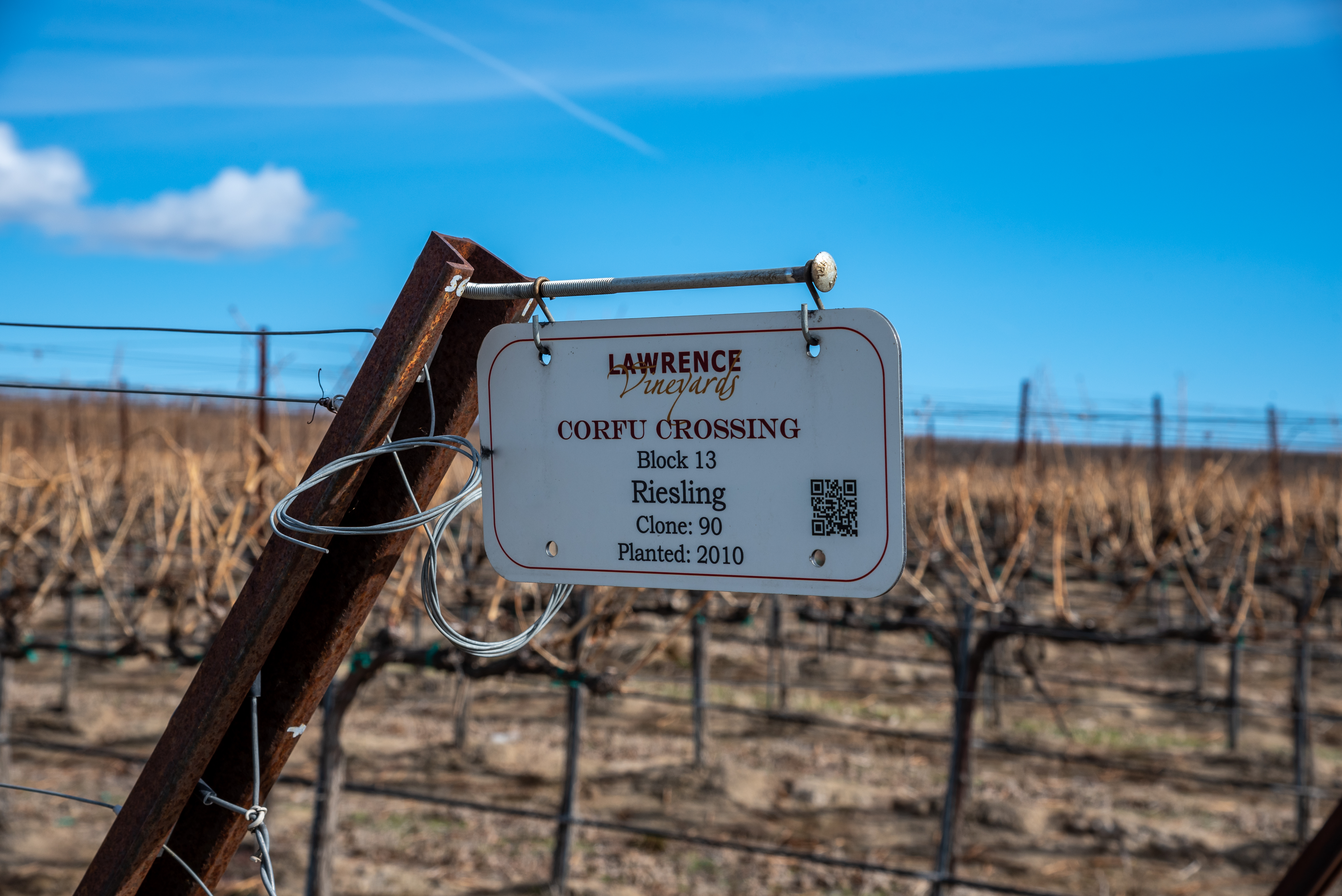
White grapes are also planted in the Royal Slope AVA, they include Chardonnay, Chenin Blanc, Gewurztraminer, Pinot Gris, Riesling, Roussanne, Sauvignon Blanc, Semillon, and Viognier.
The Royal Slope AVA is 156,389 acres, of which 1,900 acres are currently planted to wine grapes and there are 13 commercial vineyards and two wineries located within Royal Slope, Foxy Roxy Wines and Burke Vineyard.
Lawrence Vineyards & Gård Vintners

The addition of Royal Slope to the list of official Washington State AVAs was was welcome news to wine grape growers Josh and Lisa Lawrence, Owners of Lawrence Vineyards located in the appellation. The Lawrence family who planted their flagship Corfu Crossing Vineyard in 2003 has been farming for over five decades in this agriculturally rich area. Josh currently oversees about 450 acres of vineyards within Royal Slope including their Scarline, La Reyna Blanca, Laura Lee, Solaksen, Thunderstone, Stoneridge and Boneyard Vineyards.

Josh and Lisa Lawrence, Owners of Lawrence Vineyards and Gård Vintners (Photo Credit Gård Vintners)
Along with selling premium wine grapes to vintners across the state, the Lawrence family also operates an estate winery, Gård Vintners which was established in 2006 and is located in Walla Walla. Now Gård Vintners who produces wines based 100% from Royal Slope and a multitude of other wineries may add the Royal Slope AVA designation to their wine labels.

This collection is available on the Gård Vintners website. The 3-pack sells for $135.
A great way to experience for yourself some of the wines that feature grapes harvested from the Royal Slope AVA is to try the Collection Series from Gård featuring 2016 Cabernet Sauvignon from three Lawrence Vineyards sites: Laura Lee, Corfu Crossing and Scarline. The Gård Vintners’ Collection Series showcases the unique characteristics of these three specific estate vineyard sites on the Royal Slope. The diversity of each location delivers a high level of uniqueness and complexity to the wines produced by Gård.

Planted in 2008 the Corfu Crossing Vineyard has an elevation of 1,400-1,460 ft The soil is Taunton silt loam and the vineyard is Farmed using organic practices. Visit the Lawrence Vineyards Website to learn more about Corfu Crossing Vineyard.

The 2016 Corfu Crossing Cabernet Sauvignon: This engaging Washington Cabernet opens with aromas of a blackberry & blueberry pie with combined with swirls of licorice and spice, topped with smoky vanilla and plum ice cream. A wonderful visual picture just from the aromas. With time in the glass the wines flavors open up and the plum flavor becomes more pronounced. Add in the intriguing notes of dried herbs and orange zest and the full picture of this unique style of this Cabernet becomes even clearer.
A lovely easy drinking Cabernet Sauvignon that has a generous mouthfeel with an air-kiss of sweetness and a savory oaky long finish.
You can read more about Gård Vintners and an interview that I had with Lisa Lawrence on my previous post Washington Wine Gift Ideas for the Holidays.
Mullan Road Cellars
In 2012 Napa vintner Dennis Cakebread (of Napa Valley’s famed Cakebread Cellars) set out to make a singular Washington State Cabernet Sauvignon-based red wine that encompassed both the deep history and terroir of the Northwest. Finding camaraderie in the Walla Walla community and being drawn to the high-quality wines of the area, Dennis knew his next project would be in Washington, especially in the newly founded Royal Slope AVA region. Mullan Road Cellars is the result of this newest endeavor.

Premium producers such as Mullan Road Cellars that use 90% of their grapes from this AVA will now be able to change their labels from reading Columbia Valley to Royal Slope AVA.
Solacksen Vineyard and Stillwater Creek Vineyards two of the established vineyards in the Royal Slope AVA have terroir that is ideal for growing all Bordeaux varieties, including Cabernet Sauvignon, Merlot and Cabernet Franc, the grapes blended into Mullan Road Cellars’ red wine.
Mullan Road Cellars 2015 Red Blend Wine: A blend of 49% Cabernet Sauvignon, 34% Merlot, and 17% Cabernet Franc and aged 18 months in 34% new French and American oak barrels this Washington Cabernet is decadent and tantalizing. Brimming with loads of sweet black and red fruit aromas mingled with chocolate, baking spice and hints of dill you also get a deeper scent of cassis as the wine opens up. This full-bodied gem has silky tannins that give it an elevated elegance. Deeply layered with a wonderful concentration of the aroma flavors carrying over and the addition of plums and smoked embers. Refined and Precise this Cabernet gets sexier with each sip.
The Benefit of Listing an AVA on a Wine Label
Protecting a wine’s origin within an established AVA according to the federal appellation labeling rules assure consumers that when they buy an appellation-designated wine, they are buying a product wherein both the grape source and the place of production are closely tied to the named place. Also, an AVA recognition allows vineyard owners and wineries to distinguish themselves by showcasing the characteristics, quality or reputation of their grapes. Equally important an AVA listed on a label gives consumers a better idea of what a wine is going to taste like and allows comparison to other wines made from the same area.
“If certain information about a wine is included on the label, an appellation of origin is required. An American viticultural area (AVA) is a type of appellation specific to grape wine. It is a defined grape-growing region having a name, distinguishing features, and a delineated boundary.” From the TTB Website.
How Washington wines are labeled: In Washington if the label states “Washington” and the name of an American Viticultural Area (AVA) located wholly within Washington, at least 95% of the grapes used in the production of the wine must have been grown in Washington. The same grape percentage is also required if the label states “Washington” only or if the label states “Washington” and the name of an AVA located in both Washington and an adjoining state.
Upcoming Washington AVA Post
Although Taste Washington Wine Month is coming to an end there are still 14 more Washington AVAs to explore this year.

Image from Getty Images
It was over 200 years ago that pioneering explorers Meriweather Lewis and William Clark traversed the spectacular terrain of Washington State. The same expansive vistas and scenic landscapes that captivated Lewis and Clark still remain but explorers of Washington state today have the opportunity to discover something that they did not witness; Washington’s dynamic wine regions. The Next Washington AVA post will take us to the appellation named after these two daring explorers, The Lewis and Clark Valley AVA. This AVA overlaps into the states of Idaho and Washington, it covers portions of Nez Perce, three counties in northern Idaho and three Counties in southeastern Washington. I look forward to sharing more about the AVAs geography, history and wineries with you.
Images and content © Drink In Nature Photography and Drink In Life Blog.
Welcome to Drink In Life! I’m Elaine—a writer, wine expert, photographer, and lifelong collector of moments that deserve to be remembered. This space began as a place to share the beauty I found in a vineyard’s quiet morning light, the rhythm of travel, and the way a glass of wine can hold history, place, and emotion all at once. Whether you’re here for the wine, the words, or something in between, I’m glad you found your way. The stories are just getting started.

WSET Level 3 with Merit

American Wine Expert

Oregon Wine Expert-Napa Valley Wine Academy

Member of

Professional Reader


